
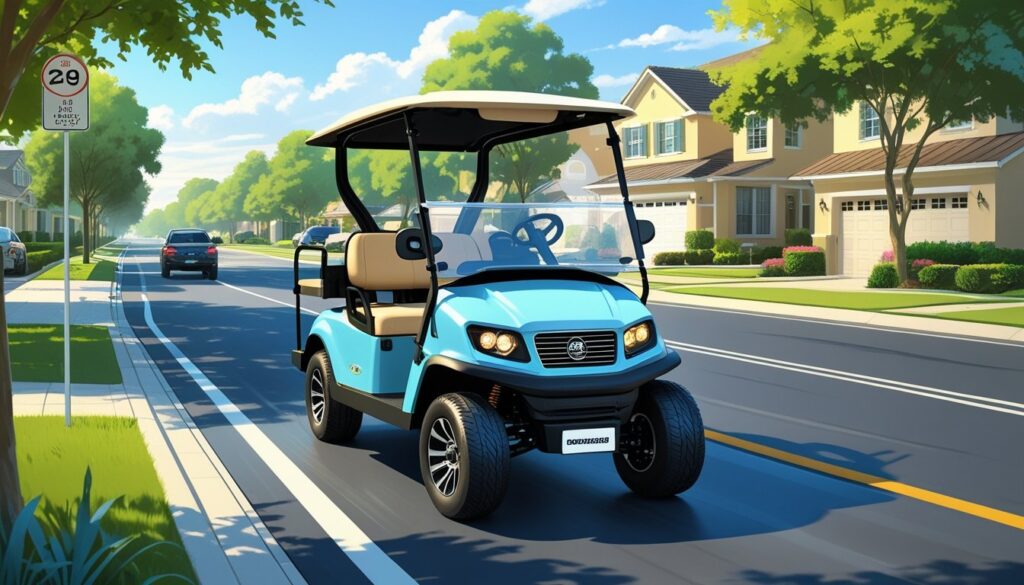
Golf carts are no longer limited to the course—they’re now a popular choice for short trips, neighborhood errands, and community transportation. But before you take yours on the road, it’s important to understand when and how golf carts can legally share public streets with cars.
Cricket Carts Direct designs and sells compact, efficient carts that meet a wide range of mobility needs—from gated communities to campus use. Whether you’re looking for a street-ready model or a cart that can be upgraded safely, choosing the right build helps you stay compliant with local and state regulations.
This guide explains exactly what makes a golf cart street-legal, which safety and registration steps matter most, and how laws differ by state. You’ll also find practical tips for safe driving, required equipment, and how to confirm if your area allows golf carts on public roads.
Are Golf Carts Allowed on Public Roads?
Rules vary by vehicle type, speed capability, and location. Some carts qualify as low-speed vehicles (LSVs) and can use certain streets if they meet equipment and registration rules; standard golf carts usually cannot.
Understanding Standard Golf Carts vs. Low-Speed Vehicles
Standard golf carts are built for courses and usually lack headlights, turn signals, seat belts, and a VIN. Because of that, you normally cannot drive a standard golf cart on public roads. Low-speed vehicles (LSVs) are either factory-built or upgraded to meet federal and state safety rules.
They must have headlights, taillights, turn signals, mirrors, a windshield, seat belts, a VIN, and a top speed between 20 and 25 mph. If your cart meets those specs, you can often register and insure it as an LSV and use it on approved roads.
Where Golf Carts Can Legally Be Driven
You can usually drive an LSV on roads with posted speed limits of 25–35 mph or lower, depending on state law. Many towns let golf carts use local streets but ban them from state highways and fast roads. Some places restrict operation to daylight hours unless the cart has proper lighting.
Local ordinances often mark which streets allow golf cart traffic. Crossings over higher-speed highways are sometimes allowed only at intersections. Always check signs, registration rules, and whether your cart needs insurance and license plates before driving.
Low-Speed Vehicle (LSV) Standards
In some states, golf cart operation on public roads is explicitly limited by law. Virginia’s traffic code specifies that golf carts can only be operated on public highways with posted speed limits of 25 mph or less.
Additionally, the driver must hold a valid license, and the cart must display a slow-moving vehicle emblem. These statutory rules define where, when, and how carts can legally share local streets.
Role of State and Local Laws
State laws set baseline rules for LSVs and whether golf carts can use public roads. Many states allow local governments to decide if carts may operate on city streets. That means your city or county may require permits, inspections, or limits on speed and hours.
Local rules vary widely. Some places require drivers to be licensed and set minimum ages. Others ban carts entirely on public roads. Before you drive, confirm both state statutes and your town’s ordinances to avoid fines or impoundment.
Making a Golf Cart Street Legal
You need certain safety gear, a proper vehicle classification, and local registration to drive a golf cart on public roads. Different rules cover equipment, whether your cart qualifies as an LSV or NEV, how to get a plate, and where you may legally drive.
Required Equipment and Modifications
To meet LSV rules, equip your cart with headlights, taillights, brake lights, turn signals, and reflectors. Add a windshield, windshield wipers if required locally, and DOT-approved tires for road use. Install a horn, side mirrors, and rearview mirrors so you can signal and see other traffic.
Seat belts for every seating position are commonly required. You also need a VIN (vehicle identification number) before registration. Many states reference federal standards like 49 C.F.R. § 571.500 for LSV safety features, so use DOT-compliant parts when possible. Keep receipts for all modifications for inspections.
Low-Speed Vehicle (LSV) and Neighborhood Electric Vehicle (NEV) Classification
An LSV must be capable of 20–25 mph and meet federal LSV standards under 49 C.F.R. § 571.500. If your cart fits this range and the safety checklist, states will often register it as an LSV or NEV. NEV is a similar local term used by some jurisdictions for slow electric neighborhood vehicles.
If your cart can’t reach the minimum speed, it may be limited to private property or specific golf cart zones. Modified carts that exceed 25 mph usually lose LSV status and need full vehicle registration and inspection like passenger cars. Confirm the numeric speed limits with your DMV before you modify.
Registration and License Plate Process
To register as an LSV, you’ll usually need a VIN, a title application, proof of insurance, and payment of registration fees. Visit your state DMV or county office for inspection schedules and VIN assignment if your cart lacks one.
Many states will issue a license plate or a special “Golf Cart” plate when registration is complete. Bring documentation showing required equipment (photos and receipts help). Insurance is commonly mandatory; carry proof while driving.
Expect local variations: some counties allow temporary permits, others require an official VIN inspection. Keep your registration and insurance in the cart when you drive.
Designated Golf Cart Paths and Special Roadways
Local laws often create designated golf cart paths, golf cart zones, or allow carts within a limited distance of golf courses. These rules can let lower-speed carts use some streets without full LSV conversion.
Typical limits include roads with posted speed limits of 35 mph or less and distance limits like within two miles of a golf course.
Check city or county ordinances and HOA rules before driving. Some municipalities require special permits or decals to use sidewalks, bike lanes, or specific crossings. Use designated paths where available and obey signage that restricts cart access to certain hours or areas.
Driver and Insurance Requirements
You must meet license, age, and insurance rules before driving a golf cart on public roads. Rules vary by state and by whether the cart is a standard golf cart or a low-speed vehicle (LSV).
Valid Driver’s License and Age Restrictions
You usually need a valid driver’s license to operate a golf cart on public roads. States commonly treat LSVs and street-legal golf carts like cars, so a standard driver’s license (Class D in many states) is required.
If you only drive on private property or inside many golf courses, a license often is not required, but local rules can differ. Age limits also matter. Some states allow drivers as young as 14 on certain low-speed public roads or community streets, while others require the regular driving age (typically 16).
Rental companies almost always require drivers to be 18 or older and to show a photo ID. Check your state DMV rules and any community ordinances before you let a teen drive.
Insurance and Liability Coverage
If you drive a golf cart on public roads, you usually need liability coverage. Many states require an LSV to carry vehicle liability insurance similar to a car. Your homeowner’s policy may not cover road use, so verify with your insurer.
- Bodily injury liability — pays others’ medical costs if you cause a crash.
- Property damage liability — pays for damage you cause to others’ property.
- Collision and comprehensive — optional, covers damage to your car.
If you let someone else drive your cart, confirm whether your policy covers permissive drivers. Without proper coverage, you could face out-of-pocket bills, fines, or a denied claim after an accident.
Personal Injury Protection Considerations
Personal Injury Protection (PIP) can help pay medical bills for you and your passengers after a crash. States that require PIP for cars may also apply similar rules to LSVs on public roads.
If PIP is available, it often covers medical care, lost wages, and some rehabilitation costs regardless of fault. If your state does not require PIP, consider adding medical payments (MedPay) or umbrella liability to reduce your personal risk.
Also, check passenger limits and seat belt requirements; failure to follow safety rules can reduce or void PIP/MedPay benefits. Contact your insurance agent to confirm what medical coverages apply when a golf cart leaves private property.
Essential Safety Features and Equipment
You need specific gear to make your golf cart safe and legal on public roads. Key items include lighting for visibility, restraints and reflectors for crash safety, and mirrors, a windshield, plus a secure parking brake to control the cart.
Turn Signals and Lighting
Turn signals, headlights, taillights, and brake lights let other drivers know your moves. Install amber turn signals on both front corners and red signals or brake lights at the rear. Use DOT-compliant bulbs or LEDs rated for road use.
Headlights should provide clear forward visibility at night and in low light. Low and high beam functions help when you face oncoming traffic. Add taillights and a bright third brake light so following drivers see you stop.
If you have an electric golf cart, wire lights to the 12V or 48V system through a proper fuse and switch. Test lights before every trip and replace cracked lenses or dim bulbs right away.
Seat Belts and Reflectors
Seat belts reduce injury risk in sudden stops or collisions. Fit a lap belt for each seat at a minimum; a three-point belt is better if the frame and mounting points support it. Make sure belts lock and retract smoothly.
Reflectors boost visibility when lights hit your cart from the side or rear. Mount red reflectors on the rear and amber on the sides. Use reflective tape along the back edge if your cart lacks factory reflectors.
For electric golf carts, ensure belt mounts attach to the frame, not just plastic trim. Check belts and reflectors monthly for wear, cracks, or loose mounting hardware.
Mirrors, Windshield, and Parking Brake
Mirrors give you views of traffic without turning your head. Fit a flat rearview mirror and at least one side mirror. Adjust them so you can see 3–4 car lengths behind you.
A windshield reduces wind, rain, and debris. Use DOT-approved acrylic or safety glass and include a wiper if you drive in wet conditions regularly. A windshield also helps if you add a heater or ventilation.
A reliable parking brake prevents rollaways when parked on slopes. Test the brake on a gentle incline before trusting it. For electric golf carts, maintain the mechanical and electronic brake linkages and replace worn pads or drums promptly.
Rules, Restrictions, and Local Variations
Laws change by state and town, so you must check local rules before driving a golf cart on streets. Requirements often cover where you can drive, what equipment is needed, and what tickets you may get if you break the rules.
Road Types and Speed Limitations
Many places limit golf carts to roads with speed limits at or below a specific threshold—commonly 25–35 mph. If a road’s posted speed is higher, you usually cannot drive a standard golf cart there unless it is registered as a Low-Speed Vehicle (LSV) and meets safety equipment rules.
Some jurisdictions allow cart use on residential streets, golf course access lanes, and designated “golf cart routes.” Others permit only short crossings of higher-speed roads at marked intersections. Always look for local signs that mark permitted routes.
If your cart has LSV features—headlights, turn signals, mirrors, seat belts, VIN, and registration—you can access more roads in many states. Even with LSV status, some highways and multi-lane roads remain off-limits.
Common Local Ordinance Restrictions
Cities and counties often add rules beyond state law. These rules may set age minimums, require permits, or ban cart use after dark without lights. They can also restrict hours, require adult supervision for young drivers, or limit the number of passengers.
You may face parking rules, too. Some towns prohibit parking carts on public rights-of-way or require special parking spots near trails and beaches. HOA or community rules can further restrict cart use inside private developments.
Before you drive, contact your town clerk or the Department of Motor Vehicles. Local ordinances vary widely, and a phone call or municipal website search can save you from fines.
Traffic Laws and Citations
When you drive a golf cart on public roads, you must follow traffic laws like stopping at stop signs, yielding, and using signals. If your cart is classified as an LSV, many states require insurance and registration similar to low-speed cars.
Violations can lead to citations for improper operation, lack of required equipment, or driving where carts are banned. Fines range by jurisdiction; some issues can also lead to impoundment of the cart or points on a driver’s license.
If an officer stops you, show registration and proof of required equipment when asked. Carrying copies of local permits and insurance reduces the chance of a ticket.
Benefits, Risks, and Best Practices for Golf Cart Road Use
Driving a golf cart can save you time, cut fuel costs, and lower emissions, but it also raises safety and legal concerns. You should weigh equipment needs, road limits, and local rules before taking a cart onto public streets.
Advantages of Using Golf Carts on Roads
Electric golf carts cut your fuel spend and reduce pollution compared with cars for short trips. Use them for errands, short commutes inside neighborhoods, or moving around campuses where speeds stay low.
They cost less to buy and maintain than cars, and charging an electric cart is cheaper than filling a gas tank. Many communities permit Low-Speed Vehicles (LSVs) on roads with posted limits of approximately 25–35 mph.
This allows you to legally travel on local streets if your cart complies with equipment and registration requirements. That makes quick trips easier and parking simpler. For short distances, you save time and avoid the hassle of finding car parking.
Potential Dangers and Safety Tips
Golf cart safety matters because these vehicles offer less protection than cars. You are more vulnerable to injury in crashes, rollovers, and collisions with faster traffic. Night driving adds risk unless your cart has proper headlights, taillights, and reflectors.
Always wear seat belts if installed, keep speeds under local limits, and avoid roads with speed limits over 35 mph unless the law allows otherwise. Install mirrors, turn signals, and a windshield if you plan on road use.
Check batteries and brakes regularly and replace worn tires. Never drive under the influence. Carry required registration and insurance when operating on public streets.
Community Trends and Environmental Impact
Many towns add lanes and ordinances to support golf carts, creating designated routes and parking. Check local ordinances; some areas restrict carts to certain streets or require curfews. Neighborhoods that allow carts often see less car congestion on short trips and more local mobility for older residents.
Electric golf carts reduce greenhouse gases compared to gasoline vehicles, especially if your power comes from clean sources. They also lower the noise. Batteries need proper disposal or recycling to prevent chemical pollution.
Drive With Confidence and Compliance
Understanding when and where a golf cart can be driven on public roads requires careful attention to federal and local laws. By equipping your cart with the right safety gear, meeting low-speed vehicle (LSV) standards, and verifying insurance and registration requirements, you reduce risks and avoid fines.
Every cart from Cricket Carts Direct is built with quality and reliability in mind, giving you confidence in both private and community use. Choosing the right configuration and accessories means your cart handles safely, meets legal requirements, and serves your daily travel needs.
Explore street-legal options, confirm local ordinances, and reach out to our team to ensure your electric cart setup works with the rules where you live and drive.
Frequently Asked Questions
You’ll find clear rules on equipment, licensing, age limits, where carts can go, how to register with the DMV, and what to look for when buying. These answers focus on California laws and common local practices you’ll likely encounter.
What are the requirements to make a golf cart street legal in California?
In California, a golf cart must meet the Low-Speed Vehicle (LSV) standards to use most public roads. That includes having headlights, taillights, turn signals, mirrors, a windshield, seat belts, and a VIN. The vehicle must be capable of speeds between 20 and 25 mph.
You’ll also need DOT-approved tires and a horn to comply with safety rules. Local ordinances can add extra requirements. Check city or county codes because some places require additional lights, reflectors, or specific signage.
Do I need a driver’s license to operate a golf cart in California?
Yes. If you operate the golf cart on public roads as an LSV, you must have a valid driver’s license. You must follow the same traffic laws that apply to other motor vehicles. For limited local exceptions (private communities or very restricted local routes), rules can vary, but carrying a license is the normal legal requirement.
At what age is one permitted to drive a golf cart in California?
California does not set a statewide minimum age for driving LSVs; you generally must meet the state’s driver’s license age rules. Most drivers need to be at least the minimum age to hold a valid license, usually 16 for a provisional license.
Local jurisdictions or private communities may allow younger drivers under specific rules. Always verify local ordinances before letting minors drive.
Are there specific areas where it’s legal to drive golf carts on public roads?
Yes. California cities and counties can pass ordinances that allow golf carts or LSVs on designated streets. Many allow them on roads with posted speed limits of 35 mph or less, but some limit use to 25 mph streets or marked routes.
Private roads, gated communities, and golf course areas often have their own rules and may allow standard carts where public roads do not.
How do I register a golf cart with the California DMV?
First, ensure your cart meets LSV equipment and safety standards. Obtain a 17-digit VIN if your cart does not already have one; a certified VIN or manufacturer VIN is required for titling.
Take the VIN, proof of ownership, required forms, and proof of insurance to the DMV to apply for title and registration. Expect inspection steps and fees; local DMV offices can list exact documents and costs.
What should I consider when buying a street-legal golf cart?
Check that the cart already has LSV equipment: headlights, turn signals, mirrors, windshield, seat belts, and a VIN. Buying a cart already titled and registered saves time and paperwork.
Confirm tire ratings, speed capability (20–25 mph), and the reliability of the battery or motor systems. Ask about past inspections, insurance history, and any local restrictions where you plan to drive.
