
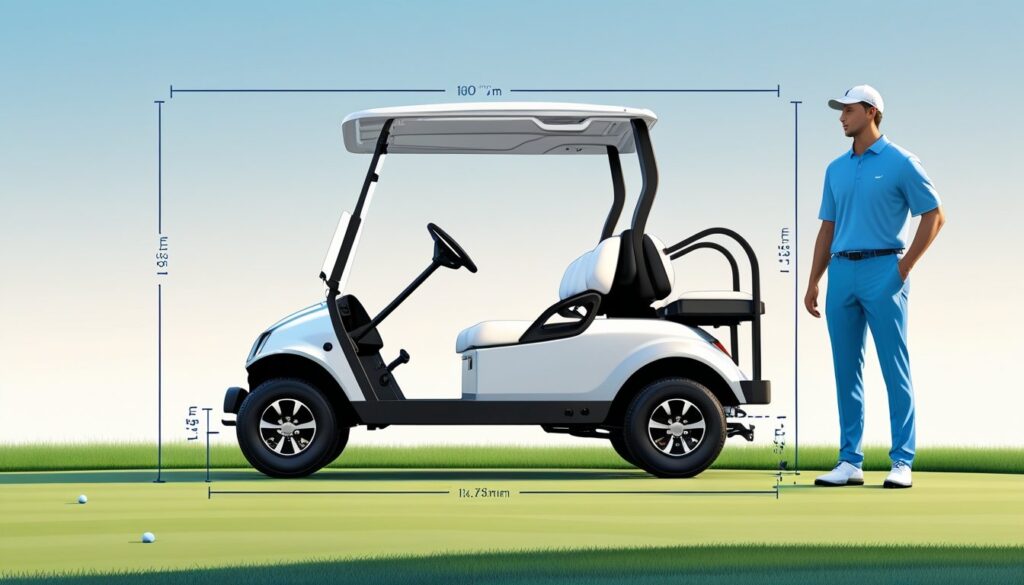
Golf carts vary more than most people realize — from compact two-seaters to extended six-passenger vehicles. Knowing their size isn’t just trivia; it’s essential for planning storage, transport, and upgrades.
At Cricket Carts Direct, every model blends comfort, smart engineering, and space-efficient design. Whether you need a portable solution for your RV, neighborhood, or golf course, the right dimensions make ownership smoother and safer.
This guide breaks down standard golf cart sizes, explains how capacity affects length and width, and helps you measure the space needed for garages, trailers, and community paths.
Standard Golf Cart Dimensions Explained
Most standard golf carts fall close to the same size: about 8–9 feet long, 4 feet wide, and around 6 feet tall. These numbers change by seating capacity and add-ons like lift kits, bigger tires, or rear seats.
Average Length of Golf Carts
Length matters when you plan storage, transport, or parking. A typical 2-seat cart measures about 92–96 inches (7.7–8.0 feet). Four-seat carts usually run 110–112 inches (9.1–9.3 feet). Six-seat or stretched carts can reach 144 inches (12 feet) or more.
Longer carts need more turning room and a longer trailer or truck bed to haul them. When measuring, include bumpers and any front or rear attachments, since those add several inches. For garage space, add at least 2 feet front and back for access and loading.
Typical Width of Golf Carts
Most golf carts are about 48 inches (4 feet) wide from outside tire to tire. That width holds true for many 2-, 4-, and 6-seat models. Some utility or off-road models widen to 50–58 inches, especially with wider tires or aftermarket wheel spacers.
Check the measurement across the widest points: tires and mirrors, if present. Width affects whether you can drive down narrow paths or fit through garage doors. A standard single-car garage (at least 8 feet wide) easily fits most carts, but tight spaces or trailers may require precise width figures.
Standard Cart Height
Standard golf cart height usually falls around 70–75 inches (about 6 feet). This measures from the ground to the top of the roof or canopy. Lift kits, roof racks, or tall tires can raise the height to 80 inches or more.
Remember vertical clearance for garages, carports, and vehicle transporters. If you add a windshield or roof-mounted accessories, measure again. Also, check legal or course rules for low-speed vehicles or neighborhood use, since height and roof structure can affect safety features and regulations.
Golf Cart Sizes by Seating Capacity
Here are typical lengths, widths, and heights for common seating options and how those dimensions affect storage, transport, and maneuvering.
Standard 2-Seater Golf Cart
A standard 2-seater usually measures about 92–96 inches long, 48 inches wide, and 70–75 inches high. That size fits most garage spaces and small trailers. You can park it beside a car or store it in a single-car garage without much trouble.
Because it’s compact, you’ll notice a better turning radius and easier navigation on narrow paths. Common models like Club Car Precedent and E-Z-GO TXT fall in this range. If you add a lift kit or larger tires, expect height to increase by several inches and width to grow slightly.
Practical tip: measure your trailer or garage opening before you buy. A few inches can change whether the cart fits with accessories like a roof or rear seat.
4-Seater Golf Cart Overview
A 4-seater typically runs 108–120 inches long, with a width usually 48–60 inches and a height of 70–75 inches. That extra 1–2 feet in length adds a rear-facing or forward-facing bench and more cargo space.
You’ll need a longer trailer or a larger garage spot compared with a 2-seater. Loading ramps should be rated for the extra length and weight. Many resort and family models use this size to carry passengers and gear comfortably while keeping a similar width to 2-seaters for path access.
If you park in a tight area, check turning clearances. The added length changes handling at low speeds and requires slightly wider turning space.
6-Seater Golf Cart Comparison
A 6-seater often measures 132–144 inches long and can be around 66 inches wide, with heights from 75–80 inches. This size fits large groups but needs careful storage and transport planning.
You’ll want a heavy-duty trailer and a longer driveway or garage bay. Maneuvering through narrow gates or between trees can be difficult due to the length. Some 6-seaters keep a narrow chassis to help with paths, but most require more clearance than 2- or 4-seaters.
Consider weight limits on ramps and lifts. The longer frame adds weight and changes the center of gravity, so secure the cart well during transport.
Dimensions of Top Golf Cart Brands
Most models sit near the same width but vary more in length and height. Pay attention to seat count and model line because those change length more than width.
Club Car Golf Cart Dimensions
Club Car two-seat models usually measure about 92–100 inches long and sit around 47–49 inches wide. If you buy a four-seat model, expect lengths near 108–110 inches. Heights range from roughly 47 to 71 inches, depending on roof style and accessories.
Check specific examples:
- Villager 2: ~92″ L × 47″ W × 68″ H.
- Onward 4-passenger: ~108″ L × 48.75″ W × 71″ H.
- Stretch/6-passenger variants: can reach 140+ inches in length.
When planning storage or transport, leave extra room for mirrors, bumpers, and cargo carriers. For a tighter fit, measure your exact model or the area where you’ll park.
Yamaha Golf Cart Dimensions
Yamaha two-seat carts are commonly around 94–96 inches long and near 47–49 inches wide. Four-seat Yamaha models usually fall in the 110–128 inch length range. Heights often sit between 48 and 72 inches, depending on roof and tire choices.
Representative sizes:
- The Drive2: ~94″ L × 47″ W × 71″ H.
- UMax Two/Three series: ~111–128″ L × 49″ W × 72″ H.
- Concierge 6: up to 160+ inches long for extended seating.
Wider off-road or utility models may exceed the typical 48″ width. Check the wheelbase and tire width if you plan to move the cart through narrow gates.
Other Notable Brand Sizes
EZ-GO and similar brands often match these ranges but show more model-to-model variation. Two-seat EZ-GO models average 92–96 inches long and 47–48 inches wide. Four-seat EZ-GO examples commonly range 107–112 inches long. Six-seat or “stretch” models can top 140 inches.
Quick reference:
- EZ-GO Express S4: ~108″ L × 48″ W.
- EZ-GO Freedom/TXT and Valor: ~93–96″ L × 47″ W.
Lift kits, larger tires, or rooftop racks add height and width. Always compare the manufacturer’s specs for the exact model before buying, storing, or hauling your cart.
Key Measurements Impacting Usage
These measurements determine how your cart fits, maneuvers, and handles rough ground. Pay attention to numbers and how they affect storage, turning, and off-road use.
Wheelbase and Track Width
Wheelbase is the distance between the front and rear axles. A longer wheelbase (e.g., 70–90 inches) gives a smoother ride at speed and more stability when carrying passengers or cargo. Shorter wheelbases make tight turns easier but can feel twitchy on uneven ground.
Track width is the distance between the left and right wheels on the same axle. A wider track (around 40–60 inches typical) lowers the chance of tipping on side slopes and improves cornering. Narrow tracks help fit through gates or narrow paths.
When you measure for storage or a trailer, use overall length plus bumper overhang, not just wheelbase. If you carry heavy loads, prefer a longer wheelbase and wider track for better balance.
Turning Radius
The turning radius tells you how tightly the cart can steer. Typical two-seat carts have turning radii near 9–12 feet; larger carts and limos may need 15+ feet. A smaller radius equals easier maneuvering in garages, parking areas, and tight course paths.
Test the cart in the space you will use most. If you often back up or do U-turns, aim for a smaller number. Steering geometry, front wheel offset, and tire size also change the effective turning radius.
When fitting a cart into trailers, remember that a larger turning radius can make loading harder. Measure your driveway or storage area and compare it with the cart’s published radius before buying.
Ground Clearance
Ground clearance is the lowest distance between the cart’s underbody and the ground. Standard carts sit around 4–6 inches; lifted models add 3–6 inches more. Higher clearance lets you cross ruts, curbs, and uneven terrain without scraping the frame.
Consider tire diameter, suspension travel, and lift kits when estimating clearance. Bigger tires raise both overall height and clearance, but can change the center of gravity and track width.
If you use your cart on paved paths only, low-to-moderate clearance is fine and easier to step into. For trails, golf courses with rough turf, or beach access, choose higher ground clearance and check stability at that height.
Golf Cart Transportation and Storage
Match your cart’s length, width, height, and weight to the vehicle or space you’ll use. Check trailer bed size, truck payload, and garage door clearance before you move or store a cart.
Battery Charging and Ventilation Safety
Proper ventilation during charging prevents gas buildup and extends battery life.
The U.S. Department of Energy advises charging electric vehicles in well-ventilated areas to manage heat and hydrogen off-gassing safely. Always follow manufacturer guidelines and avoid enclosed spaces without airflow.
Golf Cart Transportation Basics
Measure your cart first: most 2-seaters are about 92–96 inches long, 48 inches wide, and weigh 900–1,100 lbs. Use a trailer at least 5×10 feet for a standard cart, or a longer trailer for 4- and 6-seaters. Confirm the trailer’s GVWR exceeds the cart weight plus any gear.
Secure the cart with rated straps at the frame or designated tie points. Use wheel chocks and cross the straps to prevent movement. For truck bed loading, check payload capacity and tailgate length; you may need the tailgate down and extra tie-downs.
Size Considerations for Storage
Measure door height and internal depth before you park a cart in a garage or shed. A standard roofed cart can be 72–75 inches high; add 3–6 inches if lifted or if you have oversized tires. For a single-car garage, leave at least 6–12 inches of front and rear clearance for easy access.
If you store an electric cart, allow space for charging and ventilation. Use shelving or floor protection to protect batteries and tires. For tight storage, consider removing the roof or lowering seats only if the model allows it safely.
Maneuverability in Tight Spaces
Know your cart’s turning radius—typical small carts handle narrow course paths better than stretched 4- or 6-seaters. Measure gate widths and path clearances where you’ll drive; a 48–52 inch width usually fits most community paths, but added mirrors or bumpers can add inches.
Drive slowly when navigating sharp turns or narrow driveways. Practice backing and tight turns in an empty area to learn the cart’s swing and pivot points. Use spotters when needed to avoid scraping rails, posts, or low branches while loading, unloading, or parking.
Plan Your Space and Choose the Right Fit
Understanding golf cart dimensions helps you plan parking, hauling, and upgrades confidently. By matching cart size to your space, you’ll avoid transport headaches and ensure safer handling on every trip.
Every model from Cricket Carts Direct is designed for smart use of space, from collapsible frames to efficient storage footprints. These carts prove that compact design and comfort can go hand in hand.
Measure your area, check your trailer specs, and reach out to our team for expert guidance on choosing a cart that fits perfectly.
Frequently Asked Questions
Below are clear, specific answers about golf cart size, passenger options, weight limits, storage needs, and model types. You’ll find typical measurements, how extra seats change length, and what to expect for storage and payload.
What are the standard dimensions of a golf cart?
A common two-seat golf cart measures about 92–96 inches long, 48 inches wide, and roughly 70–72 inches tall. Four-seat carts usually run about 108–112 inches long, while six-seat models can be 140–160+ inches long. Width and height stay close to the two-seat size unless modified.
Can golf carts accommodate more than two passengers, and how does it affect their size?
Yes. You can get 4- and 6-passenger golf carts or add rear-facing jump seats. Adding seats increases length, and sometimes wheelbase, but width typically remains near 48 inches unless the manufacturer designs a wider model.
Is there a difference in size between electric and gas-powered golf carts?
No major size rule separates electric from gas carts; both power types come in similar two-, four-, and six-seat lengths. Model choices and accessories matter more than power type when you compare length, width, and height.
What’s the average weight capacity of a typical golf cart?
Most standard golf carts carry around 800–1,000 pounds total payload for two- to four-seat models. Heavy-duty or commercial carts handle more, often 1,200 pounds or higher, depending on frame and suspension.
How much space do I need to store a golf cart?
Plan for the cart plus clearance: allow the cart footprint (about 8–12 feet long by 4–5 feet wide) plus at least 2 feet front and back, and about 4 feet total side clearance. For a typical two-seat cart, a 10 ft by 6 ft space works. Larger multi-passenger carts need a longer bay or trailer space.
Are there different sizes of golf carts available for various uses?
Yes. There are compact neighborhood and personal carts, stretched passenger carts for resorts, and wide off-road utility carts. Select a model sized for your needs—narrow carts for tight paths, wider or longer models for carrying people or gear.
